

The Hidden ROI of Premium Branding
I counted the applications I opened before 10 AM today. The number was exactly eight. By the end of the day, that number easily doubled.
When did this become the baseline?
The reality of modern brand building is that it has very little to do with just "designing." A decade ago, mastering two or three programs made you an industry expert. Today, managing a brand's digital presence feels more like running a dedicated IT department.
Here is what it takes just to execute a standard Wednesday: Photoshop, Illustrator, Figma, Premiere Pro, InDesign, and Lightroom for visual assets. Magnific and Captions for AI generation and video processing. Notion, Asana, Jira, and Trello for project management. Slack for communication. Cyberduck and WordPress for deployment.
The expectation has fundamentally shifted. To deliver high-end results, you are expected to be a strategic thinker, a prompt engineer, a project manager, and a systems operator all at once. The tools have never been more advanced, but the cognitive load has never been heavier.
What You Are Actually Buying
Experiencing this daily cognitive load made me realize something important about the true value we bring to our clients.
When ambitious founders partner with us, they usually think they are buying a brand strategy, a visual identity, or a new digital headquarters. But the highest return on their investment isn't just the final deliverables.
They are buying their time back.
They are intentionally outsourcing this massive, invisible web of technological complexity directly to our team, so they can actually focus on running their business.
The Cost of Navigating the Noise
As a founder or CEO, your most valuable asset is your focus. Every hour you spend trying to manage a fragmented tech stack, organizing deliverables, or trying to piece together a digital presence is an hour stolen from your core business.
You cannot scale a company if you are bogged down by the friction of execution.
By partnering with a strategic studio, you eliminate that friction. We manage the complexity, streamline the technology, and deliver a cohesive system that just works.
You don't just get a high-performance brand. You get the clarity and bandwidth to focus entirely on your next stage of growth.


Why AI is the best thing to happen to premium branding
People constantly ask me if I am worried about Artificial Intelligence replacing my job as a Brand Strategist.
My answer usually surprises them: I have never been more grateful for AI. The truth is, the rise of generative design has been one of the best things to happen to our business.
Do not get me wrong—AI is a fantastic asset. Just like Photoshop, Illustrator, or Figma, it is simply a brilliant new arrow in our quiver. In fact, I love it when clients come to our first strategy meeting with rough visual ideas they have drafted using AI tools. It shows they are engaged, prepared, and ready to do the work.
But the greatest thing AI has done for the branding and design industry is not generating images in seconds. Its greatest contribution is that it has acted as a massive, uncompromising filter for the market.
It has beautifully separated businesses into two very distinct groups.
1. The Shortcut Seekers
The first group consists of businesses looking for an easy, cheap, and entirely generic solution.
People who rely entirely on AI to build their core brand identity are the ones who were always looking for a commodity. They view branding not as a strategic business asset, but as a mandatory expense—a box to check. Before AI, they were the clients searching for $50 logos on freelance platforms.
AI didn't change their mindset; it simply gave them a faster, cheaper way to get the commodity they were already looking for. And that is perfectly fine. But it is not a strategy.
2. The System Builders
The second group consists of ambitious founders who are looking for a strategic, high-performance, and tailor-made outcome.
These are the businesses that want a resilient brand ecosystem. They understand a fundamental truth of business growth: a prompt cannot replace business logic.
They know that AI can generate a stunning, pixel-perfect picture, but it cannot interview your stakeholders. It cannot audit your internal operations. And it certainly cannot architect a nuanced brand system designed specifically to out-position your real-world competitors.
The Premium on Human Strategy
Because the internet is suddenly flooded with cheap, AI-generated visual noise, true strategic clarity has become scarce. And in business, scarcity creates value.
High-level clients are realizing that standing out requires more than just "looking good," because now everyone can look good with a few keystrokes. They value the human element, the strategic alignment, and the critical thinking more than ever before.
They know they need a professional partner. They know building a high-performance system requires a premium investment. And because they want to lead their market, they are fully prepared for it.
AI is not replacing the need for brand strategy. It is simply automating the execution of commodities, filtering out the noise, and allowing us to focus entirely on the clients who are truly ready to build.
If you want a pretty picture, type a prompt. If you want to scale your business, build a system.

The scaling trap: Stop adding "more"
There is a dangerous scaling trap most founders fall into. I realized it completely by accident, away from any boardroom or strategy session, while watching my 18-month-old daughter play.
She was sitting on the floor with a small pile of about 10 Playmobil figures. She was completely immersed. She had assigned a specific role to each one, handled them carefully, and showed a genuine emotional attachment to that small group of toys.
Watching her, a thought crossed my mind: What would happen if someone suddenly dumped 50 more figures in front of her?
The answer is simple. The emotional connection would immediately break. She would no longer care about the individual figures or their unique roles. Her focus would shift entirely to the sheer volume. The game would turn from "valuing what I have" to "managing the pile and wanting the next one."
In an instant, those toys would go from being special to becoming a commodity.
As a Brand Strategist, I see ambitious founders make this exact same mistake when trying to scale their businesses.
The Illusion of "More"
When a business reaches a plateau, the instinctive reaction for most founders is to add volume. They believe that growth strictly requires more.
-
More product lines to capture different audiences.
-
More trendy AI features stuffed into their software.
-
More scattered messaging across every social media platform.
-
More noise.
But here is what actually happens behind the scenes: They dilute their brand’s core identity.
When you throw everything at the wall to see what sticks, your messaging loses its sharpness. The emotional connection you worked so hard to build with your core audience breaks, because you no longer stand for one specific, highly valuable thing. You just stand for "everything."
Falling into the Commodity Trap
When a brand loses its focus, the customer's perception shifts—just like it does with a massive pile of toys.
Customers stop seeing the unique value, the specific expertise, or the premium experience your brand offers. Instead, they start comparing you purely on metrics like price, features, and quantity.
Once your audience is only looking at your price tag to make a decision, you have lost your leverage. You are no longer a premium solution; you have become a commodity. And competing on price is a race to the bottom that no brand truly wins.
How to Scale Without Losing Your Soul
True scaling isn't about volume. It is about depth.
If you want to out-position your market and command premium pricing, you don't need to add more noise to your operations. You need to build a better system.
Scaling successfully means identifying the core value that made your customers love you in the first place, and building a high-performance brand system that amplifies that exact value.
-
Refine, don't just add. Cut the services or features that confuse your positioning.
-
Deepen the connection. Speak directly and powerfully to your ideal client, rather than watering down your message to please everyone.
-
Align your visual identity with your strategy. Ensure that every touchpoint of your brand communicates absolute clarity and premium quality.
If you are preparing for your next stage of growth, remember the simplest rule of brand strategy:
Less noise. More logic. Deeper connection.
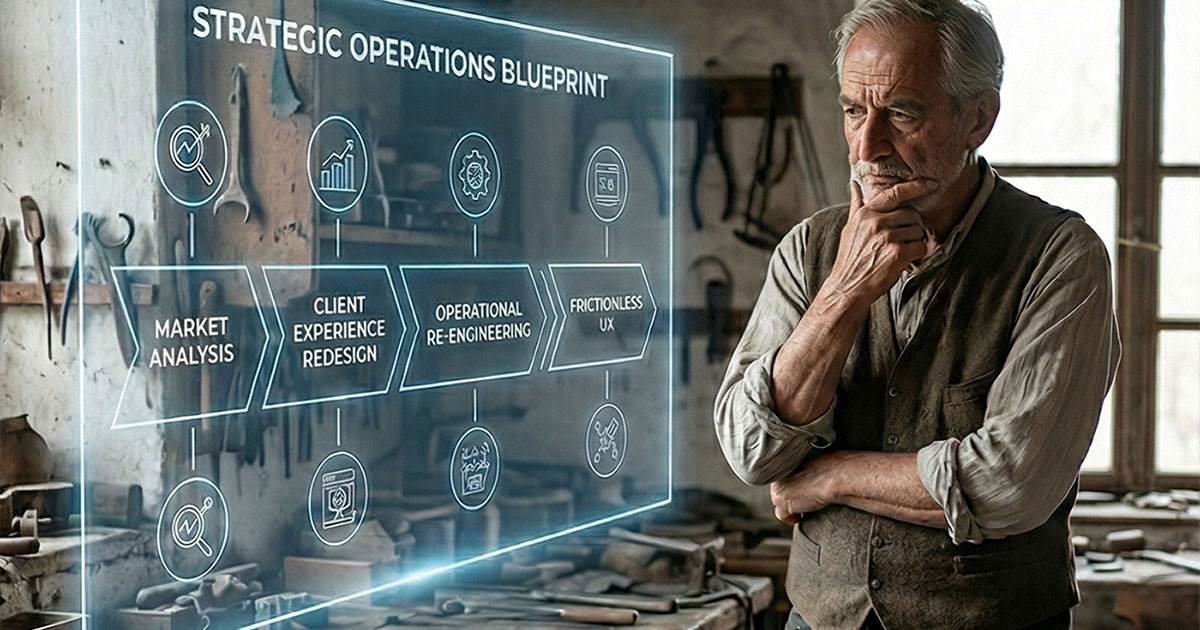
Why traditional businesses fail at rebranding
The hardest part of modernizing a traditional business isn't the market. It isn't the competition, and it certainly isn't the technology.
It is the mindset.
Recently, I sat down with two founders from very established, traditional industries. They came to me asking for exactly the right thing: a full Brand Strategy. They recognized that their market was shifting, and they wanted to upgrade their operations, elevate their positioning, and confidently step into the modern era.
But as soon as the strategy required them to actually change how they operate, they hit the brakes.
"This is how our industry works," they told me. "There is only one way to do this job."
They desperately wanted the outcome of a modern brand, but they couldn't accept the operational evolution it required. They were completely closed off to a new perspective.
This is the biggest trap for traditional professions, and it is the reason so many rebrands fail before they even launch. You cannot put a modern logo on an outdated operational model and expect the market to buy it.
Why real strategy is uncomfortable
For traditional businesses, Brand Strategy is critical, but it is also inherently uncomfortable. It forces you to look in the mirror and audit not just your visuals, but your entire business logic.
Here is why stepping into the modern era feels so daunting for established founders:
1. It challenges the legacy
Brand strategy forces you to abandon the "we've always done it this way" mentality. This is terrifying when that exact mentality is what built your business 20 or 30 years ago. It requires the humility to accept that what got you to this point will not be the thing that gets you to the next level.
2. It demands operational clarity
Strategy isn't just about what you say to your customers on a website or a brochure. It dictates how your business behaves internally to deliver on that promise. If your new brand positioning claims you are "seamless and modern," but your internal processes require clients to print and fax documents, the brand breaks. Strategy aligns the internal reality with the external promise.
3. Expertise vs. customer experience
You might have decades of undeniable mastery in your craft. But if you don't translate that expertise into a modern, frictionless customer experience, the market will ignore you. Today's consumer does not have the patience to navigate clunky processes, no matter how good you are at what you do. They will choose the competitor who offers a smoother experience, even if their core expertise is slightly inferior.
Evolution, not erasure
Humanizing and modernizing a traditional brand doesn't mean erasing its rich history. Your legacy, your years of surviving market shifts, and your deep industry knowledge are your greatest assets.
Modernizing simply means having the courage to adapt that history for today's audience. It means translating your core values into a visual and operational language that a modern consumer understands and trusts.
Strategy leads, design follows. If you are not ready to evolve how your business operates, no amount of design will save your positioning.
Are you ready to align your legacy with a modern strategy, or are you still trapped in "how the industry works"?

How a clean handoff generated over €6,000
Every designer promises "beautiful visuals." But very few talk about what happens after the design files are delivered.
Exactly two years ago, on February 25, 2024, I found myself on a stressful, two-hour drive to a hospital outside the city. My pregnant wife was next to me, suffering from severe dehydration, and my mind was entirely focused on getting her to an IV drip.
The stress was heavy. Then, my phone rang—an unknown number.
I picked it up, bracing myself for a crisis. Instead, I heard a developer named Nikos on the other end:
"I just started working on a website of one of the brands you designed. I was blown away by how organized your files and explanatory PDFs were, making my work easier. I want to send clients your way."
In that moment of panic, I thanked him and rushed inside to the doctors. Looking back, that brief phone call generated over €6,000 in unexpected referral business. Zero marketing. Zero pitch decks.
This story highlights a fundamental truth that separates commodity design from premium brand systems: Quality of work gets you the client. Quality of process gets you the partners.
The hidden cost of messy deliverables
Most business owners don’t realize that when they buy a brand identity, they aren't just paying for logos. They are paying for the implementation of those assets.
If your design files are a chaotic mess of unlabeled layers, missing font licenses, and unorganized folders, the implementation phase becomes a nightmare.
-
Developers waste billable hours trying to guess spacing and export assets.
-
In-house marketing teams accidentally use the wrong logo variations on campaigns.
-
Copywriters struggle to find the tone of voice guidelines, leading to inconsistent messaging.
When a designer delivers a messy handoff, the client pays the price in delayed launches, miscommunication, and extra development hours.
Designing for the team, not just the client
True professionalism is built backstage. Organization isn’t just OCD; it is active respect for someone else’s time.
When we deliver a Full Brand System, we treat the final handoff as a product in itself. This means:
-
Structured File Architecture: Folder systems logically organized by category (Logos, Typography, Color Systems, Layouts) with clear, standardized naming conventions.
-
The Explanatory PDF (The Blueprint): A direct, no-nonsense guide that tells developers, printers, and creators exactly how to handle the assets without needing to ask questions.
-
Clean Asset Exports: Every logo variation pre-exported in every necessary format (SVG, PNG, EPS) for both digital and print environments, correctly color-coded (RGB and CMYK).
The ROI of seamless handoffs
When you respect the workflows of developers, copywriters, and project managers, two things happen:
-
Your project launches faster and with fewer bugs, saving the client thousands of euros in friction.
-
You build a network of high-value partners who will actively advocate for you, because they know partnering with you makes their lives easier.
Before you hire a designer based on their portfolio alone, ask them a simple question: Are you designing only for the end visual, or are you designing for the team that has to build it?